


The JournalTaxes
How Are Multi-Member LLCs Taxed in the U.S.?
By Andres Platts · June 27, 2025 · 4 min read
Quick answer
Multi-member LLCs offer operational and tax flexibility for their owners, but their taxation can be complex. This blog explains how these entities are taxed, how profits are distributed among partners, and what strategies you can use to optimize your tax burden.


If you own or are considering forming a multi-member LLC in the United States, understanding its taxation is essential. Multi-member LLCs are flexible structures that combine operational and tax benefits, but they also involve complexities in dividing profits and paying taxes.
In this blog, we’ll explore how multi-member LLCs are taxed and what strategies you can implement to maximize tax benefits.

1. What is a Multi-Member LLC?
A multi-member LLC is a limited liability company with more than one owner (called "members").
Key Features:
- Protects the personal assets of the members.
- Offers flexibility in tax structure.
- Members can include individuals, other LLCs, or corporations.

2. How Are Multi-Member LLCs Taxed?
By default, multi-member LLCs are treated as partnerships by the IRS. This means they do not pay taxes directly; instead, profits and losses are distributed among the members and reported on their individual tax returns.
2.1 Taxation as a Partnership
- Form 1065: The LLC files this form with the IRS to report the company’s income and expenses. When the LLC has foreign members, it must apply withholding taxes: 21% for legal entities and 37% for individuals .
- K-1 for Members: Each member receives a K-1 form detailing their share of profits or losses, which they report on their individual return (Form 1040).
- Applicable Taxes: Members pay: Individual Income Tax: According to their tax bracket. Self-Employment Tax: 15.3% to cover Medicare and Social Security.
- Individual Income Tax: According to their tax bracket.
- Self-Employment Tax: 15.3% to cover Medicare and Social Security.
2.2 Option to Be Taxed as an S-Corp or C-Corp
Members can elect for the LLC to be taxed as:
- S-Corporation : Profits still pass through to members to avoid double taxation, but self-employment taxes can be minimized.
- C-Corporation : The LLC pays taxes at the corporate level, and members are taxed only on dividends received.
When to Consider This Option:
This means they do not pay taxes directly; instead, profits and losses are distributed among the members and reported on their individual tax returns.
- If profits are high and you want to retain them within the company.
- To take advantage of specific deductions and tax benefits.

3. Profit Distribution in a Multi-Member LLC
How profits and losses are distributed depends on the LLC's Operating Agreement .
3.1 Proportional to Capital Contributions
If not specified otherwise, the IRS assumes profits are divided in proportion to each member’s initial investment.
3.2 Custom Distribution
With an Operating Agreement, members can agree to distribute profits differently, for example:
- Based on time dedicated to the business.
- According to specific roles or responsibilities.
We invite you to calculate your company's tax payment here .


4. Tax Benefits of a Multi-Member LLC
- 01Avoiding Double Taxation : Taxation as a partnership allows profits to pass directly to members, avoiding corporate taxes that affect C-Corps.
- 02Expanded Deductions: Members can deduct business expenses such as: Business-related travel. Equipment and supplies. Home office expenses.
- 03Tax Flexibility: You can choose the tax structure that best fits the business needs.
- 04Personal Asset Protection: As with any LLC, members’ personal assets are protected from business debts.
- Business-related travel.
- Equipment and supplies.
- Home office expenses.
5. Practical Example of Taxation
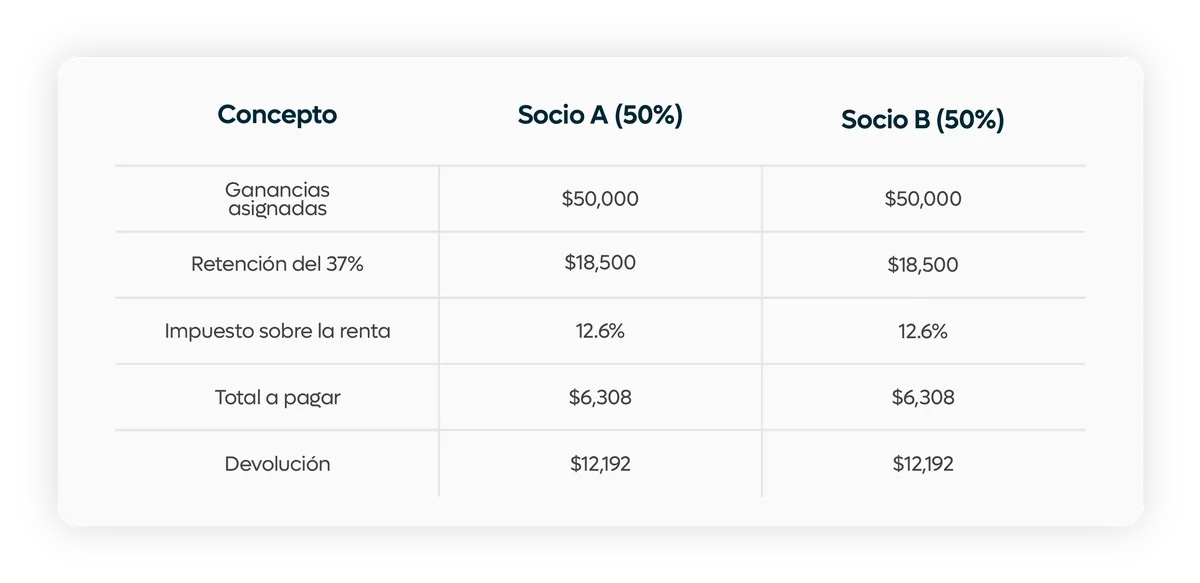
Case: A multi-member LLC with two members generates $100,000 in net income in a fiscal year.
6. How to Optimize Taxation in a Multi-Member LLC
- Maintain Detailed Financial Records: This simplifies tax filing and avoids IRS issues.
- Choose the Right Tax Structure: Analyze whether it’s more beneficial to be taxed as a partnership or a corporation.
- Maximize Tax Deductions: Review all allowable deductible expenses.
- Establish a Clear Operating Agreement: Define how profits and tax responsibilities will be divided.
- Consult with Experts : A specialized accountant can help maximize tax benefits and ensure legal compliance.

Conclusion
Multi-member LLCs are a powerful option for entrepreneurs seeking flexibility and legal protection in the United States . Understanding how they are taxed and how profits are divided is crucial to making the most of this structure.
If you’re considering forming an LLC or need help with its accounting or tax filing, our team of experts is here to assist you every step of the way .
Related Links:
- Guide to Filing Taxes in the U.S.
- U.S. Tax Season 2025


A firm or advisor? Refer clients and build alongside Prodezk.
Further reading

Taxes8 min read
What Is a Tax Identification Number (TIN)?, TIN vs SSN Explained
Understand the differences between a Tax Identification Number (TIN) and SSN. Which one do you need for your business in the U.S.? Discover real examples and common mistakes.

Taxes3 min read
2025 Tax Season: Key Changes and How to Prepare
As tax season in the U.S. approaches, we offer a complete guide on changes to the tax brackets for 2025. Discover updated rates, deductions, benefits, and strategies to make the most of the fiscal adjustments, ensuring an optimized tax return for the upcoming year.

Taxes17 min read
Why Doesn’t the United States Have a VAT? Key Differences Between VAT and US Sales Tax
Explore VAT in the United States: Why there's no federal system, how sales tax works across states, and implications for international businesses in 2026. Learn compliance tips, refunds, and cost-saving strategies from experts. Get started with Prodezk today!